

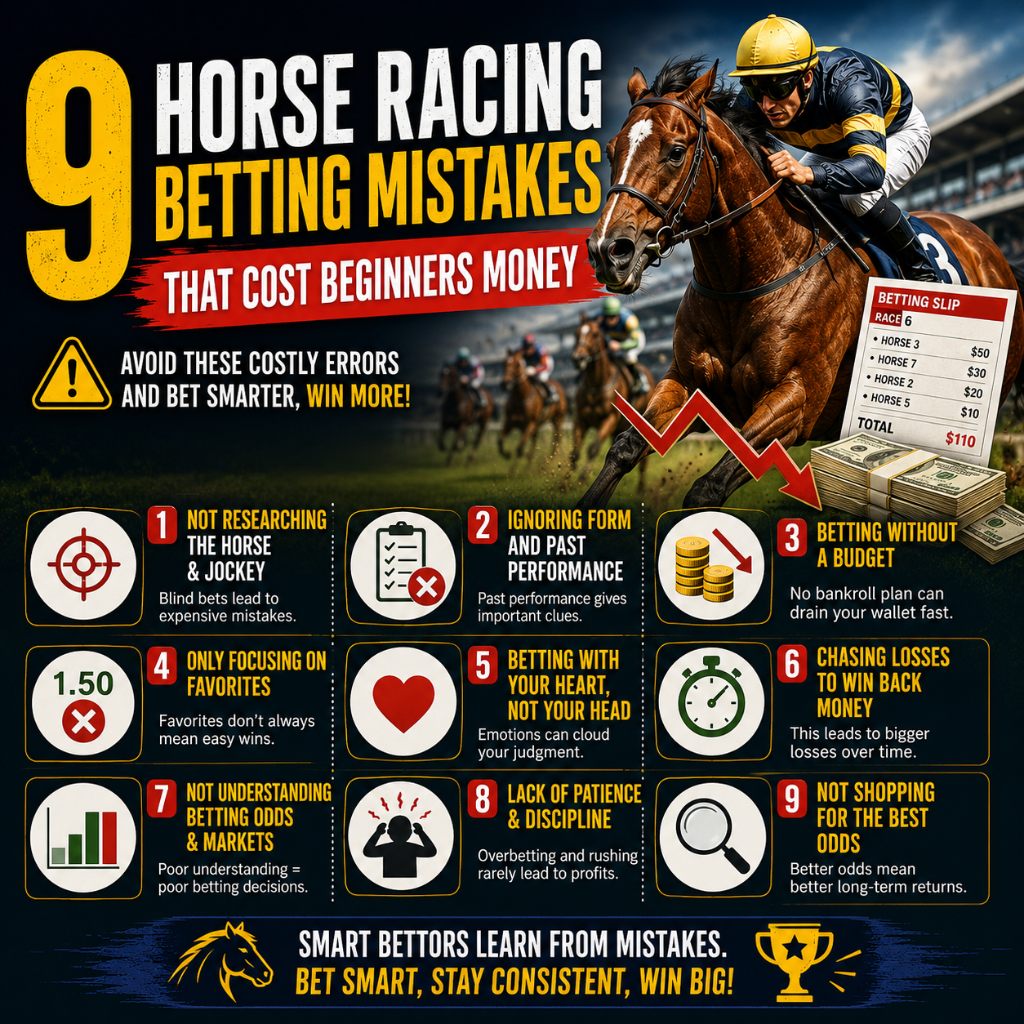
Horse racing has an undeniable pull. The thundering hooves, the sudden shift in momentum down the home stretch, and the satisfaction of picking a winner make it one of the most exciting sports to wager on. However, it is also one of the most complex. Unlike simple coin-flip style wagers, horse racing involves dozens of shifting variables: track conditions, jockey tactics, class levels, pace dynamics, and split-second strategic choices. For newcomers, the track can quickly become an expensive learning environment. Most beginners lose money not because of bad luck, but because they fall into predictable psychological and tactical traps. Here is an in-depth breakdown of nine common horse racing betting mistakes and how you can avoid them to protect your bankroll.
1. Blindly Backing the Favorite in Every Race
It is easy to assume that betting on the horse with the lowest odds is the safest path to steady profits. After all, the public and oddsmakers have flagged that horse as the most likely winner.
While favorites do win roughly 30% to 35% of horse races, consistently backing them is a mathematically losing strategy over the long run. Because the crowd heavily bets on favorites, their odds are frequently pushed far lower than their actual probability of winning. Betting $2 on a heavy favorite to win $0.40 leaves zero margin for error. A single surprise loss will wipe out the tiny gains from your previous three or four winning tickets.
The Fix: Instead of asking “Who is most likely to win?”, ask “Does the price offered match the horse’s true chance of winning?” Look for hidden value on well-rated mid-priced horses rather than accepting paper-thin returns on overhyped favorites.
2. Ignoring Track Conditions and Going Bias
A horse is not a machine that performs identically on every surface. Ground conditions—often referred to as the track surface or “going”—play a decisive role in match outcomes. Track surfaces range from fast and firm to yield, soft, or downright muddy.
Many beginners study a horse’s recent finishing positions without checking what type of track those runs occurred on. A horse that looks dominant on a bone-dry track might completely struggle on a wet, heavy surface. Similarly, certain tracks develop daily biases where the inside rail is significantly faster, or where front-runners have a massive advantage over closers.
The Fix: Always check the official track condition report before placing a wager. Cross-reference past performance logs to ensure your horse has proven form on that specific surface type.
3. Over-Boxing Exotic Bets (Exactas, Trifectas, Superfectas)
Exotic wagers like Exactas (picking 1st and 2nd in exact order) and Trifectas (1st, 2nd, and 3rd) offer tantalizing, life-changing payouts. To make winning easier, beginners often rely on “boxing” their picks—buying every single order combination for a group of horses. The hidden trap here is exponential combination growth. Boxing four horses in a Trifecta creates 24 combinations. Boxing six horses jumps to 120 combinations, costing $120 on a $1 base bet. Even if your horses finish in the top three, if the heavy favorite wins, the winning payout might only be $40—meaning you lost $80 despite technically “winning” the bet.
The Fix: Use “Keying” or “Wheel” strategies instead of blanket boxes. If you have strong confidence in one horse, key that horse in the winning spot and spread smaller coverage underneath them. This cuts ticket costs while preserving high-payout potential.
4. Betting on Too Many Races Per Card
A standard race day at a track typically features eight to ten races, and with online bookmakers, you can access hundreds of races globally every hour. Beginners often feel compelled to place a bet on every single race on the card simply to stay entertained.
Action-chasing drains capital quickly. Not every race offers clear analytical value; many maidens or chaotic handicap fields are pure lotteries. Forcing wagers on races where you have no strong analytical edge guarantees that house margins will erode your balance over time.
The Fix: Practice selectivity. Treat a ten-race card like a menu where you only order the best items. Focus your research and capital on the two or three races where you have identified a clear pricing mistake or strong tactical conviction.
5. Chasing Losses with Larger Stakes
Chasing losses is the single fastest way to destroy a bankroll. After suffering three or four consecutive bad beats, frustration takes over. The emotional urge to recoup those losses in the very next race leads bettors to double or triple their standard stake size on an impulsive, under-researched pick.
When you abandon your strategy out of desperation, you are no longer sports betting; you are gambling recklessly. A bad stretch of races is a normal part of probability variance. Doubling down during a cold streak turns minor, manageable drawdowns into fatal bankroll wipes.
The Fix: Stick to a disciplined unit-staking model. Risk a fixed percentage (typically 1% to 3%) of your total bankroll per wager. If you hit a losing streak, walk away for the day and review your form guide with a calm mind tomorrow.
6. Ignoring Class Drops and Class Climbs
Horses do not compete in a vacuum; they compete within structured class levels ranging from low-level Claiming races to Maiden, Allowance, and graded Stakes events. One of the most common beginner errors is reading a horse’s recent “1st” or “2nd” place finish without noticing the class level where it happened.
A horse that won easily against lower-class competition may struggle when stepped up to face seasoned, high-grade runners. Conversely, a horse that finished 6th in a high-caliber Stakes race might be dropping down to face far easier competition today, making them a hidden threat despite recent poor finishing numbers.
The Fix: Always evaluate class shifts. Pay close attention to horses dropping down in class (a proven sign of hidden value) or horses jumping up multiple levels after a single fluke win.
7. Disregarding Pace and Running Styles
How a race is run structurally often dictates who wins. Beginners tend to evaluate horses in isolation rather than analyzing how the entire field’s running styles will interact.
If a race contains four or five aggressive “front-runners” who all insist on setting the early pace, they will exhaust each other in a fierce early duel. This setup sets up a perfect scenario for a late-closing horse to sweep past the tired front-runners in the stretch. On the flip side, if a race has only one front-runner and no other early speed, that horse can set a comfortable, slow tempo and coast to an wire-to-wire win without pressure.
The Fix: Map out the likely pace scenario before placing your bet. Identify front-runners, stalkers, and closers to determine if the race flow favors speed or closing power.
8. Relying on “Hot Tips” and Unverified Tout Services
The horse racing world is filled with self-proclaimed insiders, tipsters, and social media handicappers offering “guaranteed locks” and “track secrets.” Beginners eager for an easy win often pay for tip sheets or blindly follow crowd rumors without doing their own due diligence.
No one has a crystal ball in horse racing. Many tipsters simply push favorites or spam multiple selections across platforms to claim fake win rates. Relying blindly on third-party noise prevents you from developing real handicapping skills and leaves you clueless about why you are making or losing money.
The Fix: Use tips only as a secondary reference point, never as the primary reason for a wager. Learn to read form guides, speed figures, and replay videos yourself so your betting decisions are built on verifiable data.
9. Failing to Keep a Detailed Betting Journal
Most casual bettors have no idea how much money they have actually won or lost over a three-month period. They remember their $200 Trifecta win clearly, but conveniently forget the dozens of $10 $20 losing tickets that slowly drained their balance.
Without tracking your results, you cannot spot your personal analytical strengths and weaknesses. You might actually be highly profitable on Turf sprint races, but losing all your gains on Dirt route races. Without data, you will keep repeating the exact same expensive mistakes week after week.
The Fix: Maintain a dedicated spreadsheet or betting log. Track the date, track, race distance, surface type, wager category, stake amount, odds, and final outcome. Review your log monthly to double down on what works and eliminate what doesn’t.
Final Thoughts
Making consistent returns in horse racing is not about luck; it is a long-term game of risk management, probability, and emotional control. By stepping back from overhyped favorites, respecting track conditions, managing ticket costs on exotics, and tracking every dollar spent, you immediately place yourself ahead of the vast majority of casual track visitors. Treat horse race handicapping like a disciplined skill, protect your bankroll, and let the math work in your favor.