

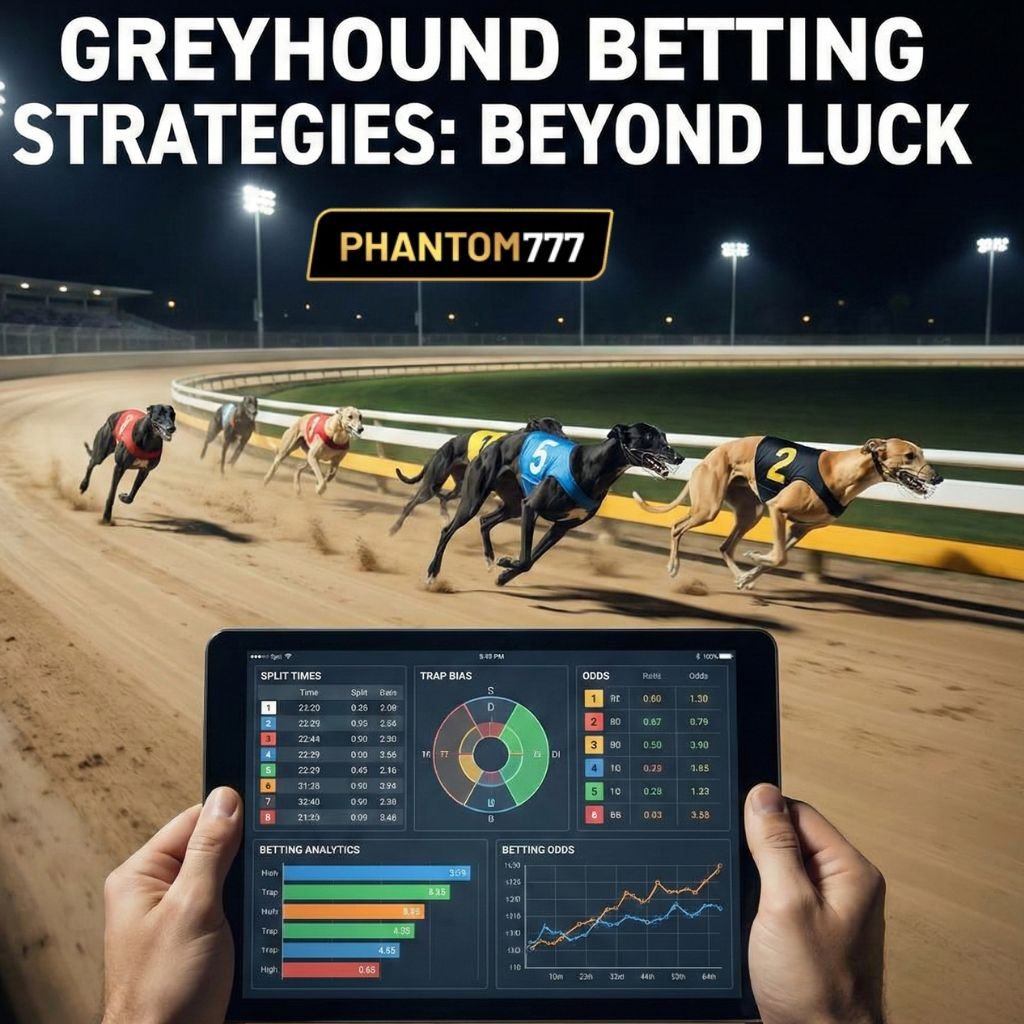
To the untrained eye, greyhound racing looks like chaos. Six dogs, thirty seconds of adrenaline, and a result that feels like a roll of the dice. However, ask any professional punter, and they will tell you the truth: Greyhound racing is one of the most statistically consistent sports in the world.
Unlike horse racing, where you have to worry about the jockey’s mood, the horse’s mind, and variable turf conditions, greyhound racing is pure physics and mechanics. The dogs are bred to chase. They do not have off days because they do not feel like running. They run on instinct. If you stop betting on names or colors and start betting on mechanics, split times, and grading, you stop gambling and start investing. Here are the professional strategies that separate the casual punters from the serious winners.
1. The “First Bend” Theory (Split Times are King)
In greyhound racing, 70% of races are won or lost at the first bend. The logic is simple: trouble happens behind the leader. If a dog can clear the pack by the first turn, it avoids the inevitable bumping, crowding, and checking that slow down the rest of the field.
The Strategy: Do not just look at the final time; look at the Split Time the time it takes to get from the trap to the finish line of the first section.
- Identify the Pinger: Look for a dog with a consistently faster split time than its neighbors.
- The Solo Leader: Ideally, you want a dog that is the only early pacer in the race. If there are three fast starters, they will likely collide at the bend. If there is only one, it will likely get a free run. A free-running dog is a winning dog.
2. The “Class Drop” Indicator
Greyhound racing operates on a Graded System (e.g., A1 is the top class, A8 is lower). This system is designed to keep races competitive. If a dog wins in A4, it gets promoted to A3. If it loses consistently in A3, it gets dropped back to A4.
The Strategy: The Downgrade is the most potent angle in betting.
- Look for a dog that has been running in a higher grade (e.g., A3) and finishing 4th or 5th, but not losing by much (maybe 2-3 lengths).
- When this dog is dropped down to A4, it suddenly runs against slower opponents. Its average run in an A3 race is often a “winning” run in an A4 race.
- Pro Tip: Be careful of dogs dropping grades due to injury or age. You want a healthy dog that was just slightly outclassed, not one that is declining.
3. Understanding Trap Bias (The Geometry of Winning)
Not all traps (starting boxes) are created equal. This depends entirely on the geometry of the specific track.
- The Inside Rail Bias (Traps 1 & 2): On tight tracks with sharp corners, the dog on the inside runs the shortest distance. If a dog in Trap 1 has decent early speed, it is tough to pass.
- The Wide Runner (Trap 6): Some dogs are “wide runners”—they naturally drift to the outside. If a wide runner is placed in Trap 1, it will move right immediately, causing a crash. If a wide runner is in Trap 6, it stays out of trouble.
The Strategy: Check the specific track statistics before you bet. If a track has a 25% win rate for Trap 1 but only 12% for Trap 5, you are fighting mathematics by backing Trap 5 unless that dog is exceptional. Always bet with the track bias, not against it.
4. The Sandwich Danger
This is a defensive strategy to save you money. You must analyze the make-up of the race specifically, who is running next to whom.
The Scenario:
- Dog A (Trap 2): Tends to move Right (towards the middle) when running.
- Dog B (Trap 4): Tends to move Left (towards the rails) when running.
- The Victim (Trap 3): The dog in Trap 3 is about to get crushed.
The Strategy: Even if the dog in Trap 3 is the fastest on paper, avoid betting on it if it is sandwiched between two dogs that will cut across its path. The risk of collision is too high. Look for a dog that has “clear air” on either side.
5. Market Movement: Follow the Smart Money
Greyhound betting pools are often smaller than horse racing pools. This means that a significant amount of money placed by a “syndicate” or a professional bettor will drastically move the odds.
The Strategy:
- The Late Drift: If a favorite suddenly drifts from 2.00 to 3.50 in the last two minutes, stay away. Someone knows something—perhaps the dog looked lame in the parade or is carrying a knock.
- The Steam: If a 6.00 outsider suddenly crashes into 3.50, pay attention. In greyhound racing, steaming odds are rarely a bluff; they usually indicate a specific confidence in the dog’s current condition or a favorable trap draw.
6. Professional Bankroll Management
No strategy works if you run out of money. The unpredictability of live animals means even the best analysis can fail due to a bad stumble or a collision.
The Golden Rules:
- Level Staking: Do not chase losses. If you bet ₹1,000 on a race, stick to that unit. Increasing your stake to recover a loss is the fastest way to bankruptcy.
- Specialization: Do not bet on every race at every track. Pick one track (e.g., Romford or Sheffield). Learn its bias, learn the local trainers, and learn the specific dogs. Specializing gives you an edge over the bookmaker who has to price up every race in the country.
Conclusion: Patience Pays
The biggest secret to greyhound betting is the ability to watch ten races and not bet on a single one.
You are looking for the perfect storm: A dog dropping in grade, with the best early split time, drawn in a favorable trap, with clear space on either side. When those factors align, you strike. That is not luck that is calculated precision.