

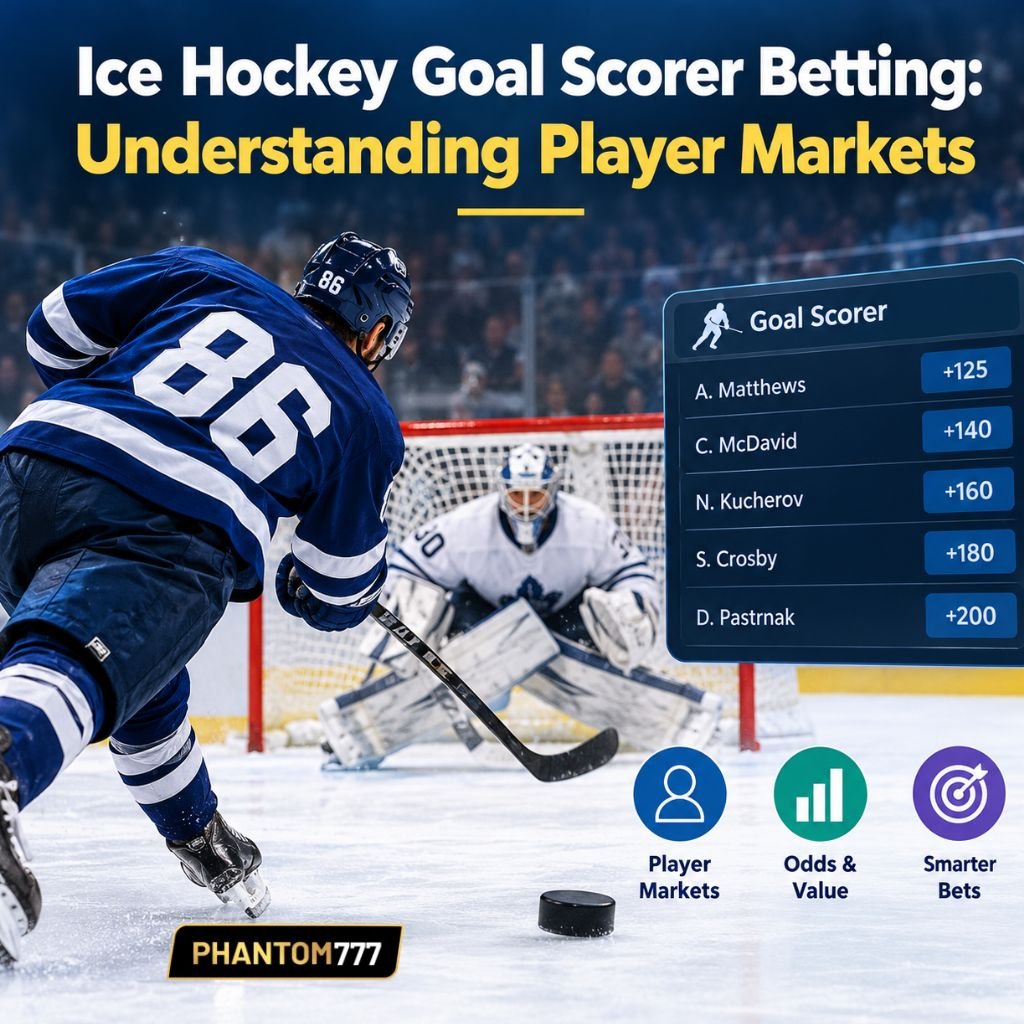
Ice hockey is one of the most high-speed, intense team sports on the planet, offering bettors rapid shifts in momentum, frequent scoring opportunities, and lucrative player proposition options. For fans utilizing a modern Sports Betting Site in india, individual player wagers specifically goal scorer markets have grown significantly in popularity. Instead of relying solely on overall match winners or point spreads, backing individual skaters to find the back of the net allows handicappers to leverage player form, forward line synergy, power-play deployment, and matchup advantages. Navigating player proposition markets requires a clear understanding of how sportsbooks structure goal scorer lines, how overtime and shootouts affect settlement, and what tactical metrics drive scoring consistency on the ice.
Primary Ice Hockey Goal Scorer Markets Explained
Sportsbooks offer several distinct ways to wager on goal scorers, each serving different risk profiles and analytical strategies.
1. Anytime Goalscorer
The Anytime Goalscorer market is the most popular and straightforward player prop in ice hockey betting. You simply pick a specific player to score at least one goal at any point during the game.
- Settlement Details: In most sportsbooks, Anytime Goalscorer wagers include goals scored during regular 60-minute regulation time as well as 5-minute 3-on-3 overtime periods. However, goals scored during post-overtime penalty shootouts generally do not count toward this market. Own goals are also excluded from individual player credit.
2. First Goalscorer
This high-yield market requires predicting which player will score the very first goal of the entire match. Because predicting the exact player to open the scoring carries higher variance, oddsmakers offer significantly longer odds compared to Anytime Goalscorer lines.
- Key Rule Nuance: If the first goal of the game is an own goal accidentally deflected into the net by a defender, sportsbooks generally disregard the own goal and settle the First Goalscorer market based on the second overall goal scored in the match.
3. Last Goalscorer
Similar to the First Goalscorer market, this selection asks you to predict which skater will score the final goal of the contest. This market often features unique late-game dynamics, as teams trailing by one or two goals late in the third period routinely pull their goaltender for an extra attacker, creating prime opportunities for empty-net goals.
4. Multi-Goal Markets (2 or More Goals / Hat-Tricks)
For elite goal scorers and top-line snipers who frequently produce multi-point performances, sportsbooks offer elevated odds on players to score two or more goals or complete a hat-trick (three or more goals) in a single game. While high in risk, these markets offer massive potential payouts when star players face leaky defensive units or weak backup goaltenders.
Key Tactical Factors Dictating Player Scoring Probability
Consistently identifying value in goal scorer markets extends far beyond checking simple season goal totals. Evaluating ice hockey props demands an examination of tactical deployment and situational usage.
Line Combinations and Time on Ice (TOI)
Top-line forwards who skate alongside elite playmakers naturally generate more high-danger scoring chances. Tracking a player’s average Time on Ice (TOI) and their specific line combination reveals their overall offensive workload. A winger playing 20 minutes a night on the top line with an elite center will receive far more scoring looks than a third-line forward averaging 12 minutes of ice time.
Power Play Units (PP1 vs. PP2)
Over 20% of all goals in professional ice hockey occur during power plays, when a team holds a numerical advantage due to an opponent’s penalty. Players deployed on the first power-play unit (PP1) receive the lion’s share of man-advantage ice time, taking shots against tired penalty-killing units. Checking whether a player sits on PP1 or PP2 is one of the strongest indicators of their goal-scoring potential.
Goaltender Matchups and High-Danger Shots
A goal scorer’s success depends heavily on the opposing goaltender they face. Analyzing the starting goaltender’s Save Percentage (SV%) and Goals Against Average (GAA) specifically against high-danger shots from the slot helps identify defensive vulnerabilities. Facing a backup goalie or a team playing the second night of a back-to-back schedule significantly increases scoring probabilities.
Choosing the Best Platform for Ice Hockey Player Props
To maximize your returns when handicapping player props, selecting a platform that offers deep market liquidity, early prop release times, and competitive odds is paramount. When evaluating a Trusted Gaming Book India, sports enthusiasts seek operators that combine wide international hockey coverage with real-time statistics and smooth account execution. For bettors looking for an exceptional, feature-rich platform to back their hockey analysis, Phantom777 delivers an elite wagering environment. Offering broad coverage across the NHL, European leagues, and international championships, Phantom777 provides extensive goal scorer markets, competitive prop pricing, fast local payment solutions, and responsive 24/7 customer service to ensure a seamless sports gaming experience.
Essential Rules Every Goal Scorer Bettor Should Remember
- Ice Time Requirement: For player prop bets to stand, the selected player must be dressed and physically take to the ice during the match. If a player is a late scratch or remains on the bench without playing a shift, bets on that player are voided and stakes returned.
- Shootout Exclusions: Goals scored during a penalty shootout do not count toward player goal totals. Only regulation and overtime goals are credited to individual goal scorer props.
- Empty-Net Scenarios: Goals scored into an empty net after a team pulls their goalie late in the game count fully toward Anytime, Last, and Multi-Goal markets.
Frequently Asked Questions
Q:Do overtime goals count for Anytime Goalscorer bets?
Yes, in most major sportsbooks, goals scored during 3-on-3 overtime periods count toward Anytime Goalscorer wagers. However, goals scored in post-overtime penalty shootouts are excluded.
Q: What happens to my goal scorer bet if the player does not play?
If the player you selected does not take a single shift on the ice during the game, the wager is declared void, and your full stake is refunded by the sportsbook.
Q: Do own goals count toward player goal scorer markets?
No, own goals do not count toward individual player goal scorer markets. If an own goal occurs for the first goal of a match, the First Goalscorer market is settled based on the next valid goal scored by a player.
Q: Why are first goalscorer odds so much higher than anytime goalscorer odds?
First goalscorer odds are higher because predicting the exact individual to score the first goal out of up to 36 skaters who see ice time carries significantly higher statistical variance than predicting a player to score at any point during 60+ minutes.
Q: Where can I find competitive odds for ice hockey player props?
Sports fans can access broad goal scorer markets, live in-play props, and competitive odds across major ice hockey leagues on trusted platforms such as Phantom777.